
 Hello, sorry I haven’t posted in a while, we have been pretty busy lately. I hope to start to have time to do posts more frequently. In this post I am going to tell you about the historic Italian town of Lucca! The picture above shows Piazza Anfiteatro. Piazza Anfiteatro is one of the main piazzas in the Historic Center of Lucca. If you were not aware, Lucca is surrounded by big brick walls, inside the walls is called the Historic Center or in Italian- Centro Storico. The Centro Storico is where all the cathedrals and landmarks are. Luckily our accommodation was inside the walls and pretty central so we were not very far from most sights we wanted to see. In Lucca, every corner you turn there is a different cathedral, our first walk around Lucca was so cool; we all thought it would be awesome to live there but a person who lived in Lucca might say the same about Toronto (probably not :). We loved walking the streets of Lucca. I hope you are able to see what our experience in Lucca was from this post.
 This is the ceiling of the Duomo of Lucca at Piazza San Martino. We were lucky enough to be 5 doors down from Piazza San Martino and loved to go to there and take in the view of the Cathedral. On the walls of the Cathedral there were stained glass images showing different priests and important figures. There were also beautifully painted works of art including the famous painting “The Last Supper” by Leonardo da Vinci (not the real one).The Last Supper depicts Jesus’s last supper before his crucifixion. My Dad and I were saying how long it must have taken to construct the cathedral because every single detail of it was paid attention to so carefully. Wikipedia tells me it was constructed in 1063 but it looks like it could have been built yesterday.
  Here is the Lucca Cathedral or in Italian- Duomo di Lucca from the outside. As you can see , the Duomo is severely asymmetrical. This is because the bell tower was already there and they started too close to the bell tower and after 2 big arches they only had room for a smaller one, creating the severe asymmetry . Talk about bad planning! 🙂
 Here is the view of Lucca from the bell tower beside the Duomo di Lucca. Piazza San Martino is kind of shaped like this <><>, the fountain below is in the second parallelogram of the piazza. Trust me, it looks less grim in the sunshine. There were a lot of spiraling stairs to get up to the viewing area, it was kind of scary on the way down because it was only a little metal stair that was separating you from a 65 ft drop. My legs were trembling the whole way down.
  On our 3rd day and 6th day in Lucca we rented bikes to bike around the city. The first time we did it we biked on top of the walls, on top of the walls there was a public path for biking and walking on (the picture above isn’t it). We went around the the walls 2 times and then returned our bikes. The next time we rented them we biked out of the walls to a path along the river called Parco Fluviale. It was really fun but very tiring. I hadn’t biked since Halong Bay in Vietnam so I was really excited to ride a bicycle again.
  Since the bike ride was very tiring we got to go for gelato! In Italy we are trying to have one gelato every day. At the end of Italy I will post about every single gelato place and rate them, maybe you will get the 10/10 you have all been waiting for. At the gelato place, Gelatiamo, I got the flavours Tutto Bosco (blueberry, raspberry, strawberry, and blackberry) and Gelatiamo (chocolate and hazelnut). It was really good. My mom got Tutto Bosco and Mango and my sister got Tutto Bosco and After Eight.
 This is the Cathedral at the biggest and most well known piazza in Lucca, Piazza San Michele. At the top of of the Cathedral there is an angel and legend says she is wearing a diamond ring because if you stand in a certain spot at night you can see a reflection of light like a diamond would make. Even though legend says that, no Italians really believe it. We sure had a great time in Lucca and I hope to be back!
Uncategorized
Map Update
UncategorizedHi, I have a map update for you, here is the link, Link. If you want to see the map just go to the map page found in the menu at the top of the blog.
Leaning Tower of Pisa
Uncategorized 3 days ago Dad, Denise, Stanley, Popo, and I set out from our Airbnb in Lucca to the train station. We were going to go on a daytrip to the The Leaning Tower of Pisa while Mom stayed at home (she had been 20 years ago). We bought train tickets at a machine and boarded our train. Most people got off at Pisa San Rossore (the station close to the tower) but we got off at Pisa Centrale (in the center of the city). We walked through the city until we got to a panini place for lunch. It was called L’Ostellino, I got a roast pork sandwich and it was really good. We then walked to the tower, we thought we might go up but it was 18 euros and kids were not allowed.
  Here is me “holding up” the tower. On the grounds of the tower there was the Leaning Tower of Pisa, the Pisa Cathedral (in Italian: Cattedrale di Pisa), and the Baptistery. We got tickets for the Cathedral and it was really cool, unfortunately we didn’t take any photos so I can’t show you it but here is a link to an image of it: Link. I think we did a pretty good job of making this photo look real.
 Here is Stanley (or as I call him Granpa) pretending to hold up the tower. The tower started to be constructed on August 9, 1173. Because the soft ground, the tower had begun to lean by the time its builders got to the third floor, in 1178. Shifting soil had destabilized the tower’s foundations. It kept leaning more and more until in 1990 it was leaning 5.5 degrees. The tower was leaning dangerously low, here is a link to it in 1990, Link. Scientists thought it would topple over so they tried to fix it and they eventually succeeded in reducing the lean to 3.97 degrees, it’s current angle.
  We walked from the tower to Pisa San Rossore and took the train back to Lucca, we walked to our apartment, and relaxed for a while before Stanley and Popo made us dinner at home and my parents went out for date night.
Guest Post: (Popo) Kefalonia Magic
Uncategorized I am honoured to have been invited to be a guest poster on Evan’s exceptional blog. For those who don’t know, I am Evan’s grandmother and comment on this blog as Baba. We are fortunate to be spending 2 weeks travelling with Evan, Denise and their parents. So, this post is about our week together on the magical Greek island of Kefalonia. As Evan foreshadowed in his post about desserts – our time together started a day later than expected. Stanley (Evan’s grandfather) and I got held up in Frankfurt because someone was flying an unidentified drone over the airspace. The Frankfurt airport was shut down for hours and our flights (and the flights of thousands of other travellers) were cancelled or delayed. After an unexpected night in Athens we were delayed by one day. The up side was that we got to see Evan and family in Athens for a little while. Once we finally arrived – we checked into Villa Mandola – as pictured above.

While we didn’t have the very best weather, we made the most of every sunny moment driving to different beaches and towns. One day we made it to Dafnoudi Beach. After a short drive and a lovely little hike – we arrived at a secluded cove with the small cave pictured above just a few steps away.

Another day we took a much longer drive to the beach at Antisamos. This was the most developed beach we visited – with excellent sun beds and good food. As you can see above – some were even brave enough to jump in the clear, turquoise but chilly waters.

As you can see – the beaches were mainly white pebbles and small stones. We found that if we moved the rocks around underneath us – they were more comfortable than expected. As the ladybugs above demonstrate – the stones also made a great base for painting with water colours and sea water.

Our drives around the island were full of amazing vistas. Each turn brought a new verdant hillside, goats scrambling up the cliffs and hidden little coves. Here is a roadside view overlooking the town of Assos. We learned that there are 365 villages in Kefalonia. Each one is marked with a sign as you enter and a sign as you leave – often with nothing in between.

But – it is the people who make the real magic. The Greek people we met were always friendly and helpful. They really wanted to share the beauty of their home. And, of course, for us, sharing our time on Kefalonia with our family was the most magical of all. Thanks so much to Denise, Evan, Jess and Dan for letting us share this experience.
The Desserts of Cephalonia and the Ekmek Story
Uncategorized Hi, sorry I haven’t posted in a while, I have kind of been taking a vacation from our vacation. I was just relaxing on the Greek island of Cephalonia. Above is a map of Cephalonia. In this post I’m gonna tell you about the desserts of Cephalonia and the Ekmek story. One of the best things about Cephalonia is at the end of the meal they always ask you if you want dessert, my parents usually say no but they bring it anyway for free. To get to Cephalonia, we took a bus from Athens to a small town called Kyllini and then we took a ferry from the mainland to the island. We then took the bus from the ferry port of Poros to Argostoli, the capital of Cephalonia. We went to a grocery store to get some groceries and then we took a taxi to our villa and waited for Stanley & Popo to arrive. If you didn’t know, Stanley and Popo are our grandparents and they are going to travel with us for 2 weeks. We were supposed to be at another villa but we weren’t for reasons Popo will tell you about in her guest post. When they arrived we all went to bed, and the next morning we all got in to our car that we rented and started to drive to our other villa, the one we were supposed to be at the night before. On the way we stopped for smoothies and coffees at a cafe called Myrtillo. I ordered the pomegranate smoothie and it was really good. We continued driving until we got to our villa, Villa Mandola. Villa Mandola was on the north of the island near a few towns called Magganos, Tzamarelata, Vasilikades, Alatias, and Fiskardo. You can see Alatias, Vasilikades, and Fiskardo on the map, Villa Mandola was in the middle of the 3.
  On to the desserts, the first dessert was Bougatsa. Bougatsa is a sweet pastry with custard inside it, and it usually has powdered sugar and cinnamon sprinkled over it. Bougatsa (like all desserts) is delicious. The first time we had Bougatsa was in Athens but we also had it in Agia Efimia and in the Cephalonia airport before leaving. If you want to learn how to make Bougatsa, here is the recipe, Link. Bougatsa was invented and is the best in the city of Thessaloniki. Unfortunately we didn’t go there. If you go to Greece you should definitely try bougatsa. If you are in Athens you should go to Bougatsa Thessaloniki. P.S. I will be very impressed if you look at the recipe and make Bougatsa.
 The next dessert wasn’t really a dessert. Koulouri the 2nd dessert was a kind of bagel. It was a big thin bagel but it was crispier than a bagel. Koulouri was really really good. The first time we had Kolouri was from a stall outside of a park, we got it for only 0.50 euros (.75 CAD). If you want to make Koulouri here is the recipe, Link . You see a lot of locals walking around with a Koulouri and an espresso freddo (a cold espresso). I love Koulouri!
The next dessert is Greek Biscuits. Unfortunately I don’t have a photo of Greek biscuits to show you. We had Greek Biscuits in Assos, a town in the middle of Cephalonia. Greek Biscuits are really good. If you are going to Assos you should go to a restaurant called Platanos and make sure to go there on a Sunday because that is the only day they serve Greek Biscuits.
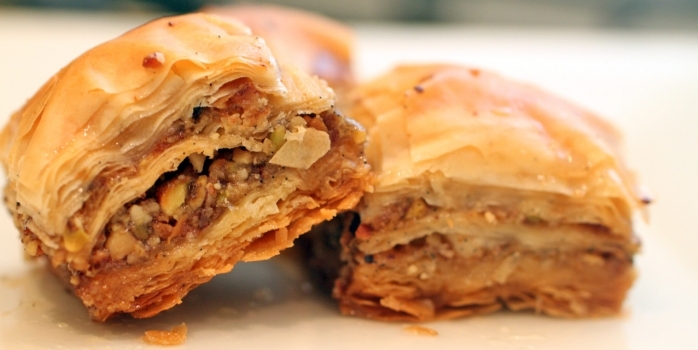
The 3rd dessert is Baklava. I’m sure many of you know about this famous greek dessert. Baklava is a honey-drizzled dessert with a lot of nuts. Baklava is very sweet so after you eat it you get really thirsty. Baklava is the perfect treat. Baklava was actually invented in Turkey but it became really popular in Greece and now it is found at many bakeries and cafes in Greece. The nuts in Baklava include walnuts, almonds, and pistachios. If you would like to make Baklava then here is the recipe, Link. I love Baklava!
 The last dessert is Ekmek. Ekmek is a creamy dessert that is really delicious. Now I am going to tell you the Ekmek story. When my family was in Vancouver we got takeout once from a Greek restaurant called The Sweet Greek. We were going to get 2 baklavas but they only had one left so we ordered one baklava and decided to try this other dessert called Ekmek. We didn’t know what Ekmek was but it turned out to be really good. I was really hoping to have Ekmek in Greece and when we were having our last dinner in Greece I was disappointed that we didn’t try Ekmek in Greece. I told my parents they owed me an Ekmek. At the end of our meal the waiter asked if we would like desserts on the house. It was our last Greek dinner so we said yes. Then the waiter brought the desserts and we asked what they were. The waiter said “In Greek we call them Ekmek”. I was really excited that we got to have Ekmek in Greece but it turns out I liked the one in Vancouver better. When we left Cephalonia we took a plane to Milan and then took a train to Florence and that is where we are right now.
Ramen in Japan
Uncategorized While in Japan we wanted to get a good amount of ramen to eat. In the end we went to 7 ramen restaurants through Japan. The restaurants were Ippudo, Hakata Issou, Ebisoba Ichigen, Ramen Shingen, Teshikaga, Fuchiki, and Kagari. We learned that the literal translation for ramen is oil noodles. Not sure if you have been there but there is a ramen place in Toronto called Kinton Ramen. Kin is gold and Ton is pork so Kinton Ramen means Gold Pork Oil Noodles. Now I am going to tell you how delicious each restaurant was and about our experience there.
 There are 4 main styles of Ramen and each style has a city that does that style best. The first style is Tonkotsu, tonkotsu is where they boil the broth for a long time with pork bones. Tonkotsu is always served with pork and Fukuoka is the city where they do tonkotsu best. The 2nd style is Miso, miso is usually served with seafood. Miso ramen can be made by 3 different kinds of miso, red, yellow, and white. White is the mildest. Sapporo is the city where they do miso best. The 3rd style is Shio. Shio is salt ramen. Shio is the most basic ramen and it doesn’t really have a place where they do it best. The 4th and final ramen is Shoyu. Shoyu is a soy-sauce based ramen. Shoyu has a clear brown broth and is not very rich. The most common ramen in Tokyo is Shoyu. The first restaurant was called Ippudo. Ippudo is a big ramen chain that has properties all over Japan. Ippudo is a tonkotsu style ramen restaurant. We went to Ippudo on our 2nd lunch in Japan in Nagoya with Dad’s friend Dan. It was delicious!
 This is the ramen at Hakata Issou in Fukuoka. The ramen there was tonkotsu. The broth of that ramen was so rich and delicious. There was a lineup to get in but it was definitely worth it. I definitely would recommend going there if you are in Fukuoka.
  The 3rd ramen restaurant we ate at was called Ebisoba Ichigen. Ebisoba was in Sapporo and it was miso style ramen. It was a popular place so there was a bit of a wait but it went fast. I loved Ebisoba Ichigen. It combined seafood with pork and it was scrumptious.
 The 4th ramen place was called Ramen Shingen. It was very good. We went there in Sapporo. The pork was a little too fatty for me but it was still a good bowl of ramen. It was a very intense environment. With the chefs yelling and steam rising. We felt pressured to eat fast because there was a lineup and all the locals ate so fast, two locals ate in the time we ate.
  Here is Denise, Dad, and I eating dinner at Ramen Shingen. One thing we were excited for at Ramen Shingen was eating Hokkaido corn, a lot of ramen restaurants in Hokkaido serve butter and corn to you to put in your ramen. The butter was good but Hokkaido corn is overrated.
  On our last night in Sapporo we went to an alley called Ramen Alley. Ramen alley had 17 ramen restaurants. At the end we were debating if we should go to Teshikaga or Ichikura. In the end we decided to go for Teshikaga. I think Teshikaga was a great choice. I ordered the Shio Ramen, Denise and Mom both ordered the Traditional Miso Ramen, and Dad ordered the All the Toppings Miso Ramen. We each got butter and corn to eat with it. The corn at Teshikaga was a lot better then the corn at Ramen Shingen.
  In Tokyo we went to a well known place in our neighbourhood called Fuchiki. If you didn’t notice, Fuchiki is on the Michelin guide. We were joking that the sign said it had 0 stars. Fuchiki was a small place with only 2 chefs but it was very good. The noodles at Fuchiki were great. Like many small restaurants, Fuchiki had a ticket machine where you choose your meal and out comes a ticket and then you give it to the chef to make. The ticket machine was in Japanese so we just winged it and went for the cheapest option. We used Google Translate to order a rice too.
 The last ramen restaurant we went to was called Kagari. Kagari was in the neighbourhood of Ginza. Kagari had rich chicken based ramen, shoyu ramen, and dipping noodles called Tsukemen. Soba usually means buckwheat noodles but here the soba on the sign means chinese noodles which is actually ramen. I ordered the shoyu, my parents ordered the chicken based, and Denise ordered the Tsukemen. You can see the chicken based ramen below.
 And now the moment you’ve all been waiting for. The ranking of the ramen restaurants from each member in my family.
Evan
- Hakata Issou
- Kagari
- Teshikaga
- Ebisoba ichigen
- Fuchiki
- Ippudo
- Ramen Shingen. My Best Bite of ramen: The 1st sip of the broth at Hakata Issou
Jess
- Hakata Issou
- Kagari
- Fuchiki
- Teshikaga
- Ebisoba Ichigen
- Ippudo
- Ramen Shingen. Jess’s Best Bite of ramen: The first taste of the broth and noodles at Kagari
Dan
- Hakata Issou
- Teshikaga
- Kagari
- Ebisoba Ichigen
- Ramen Shingen
- Ippudo
- Fuchiki. Dan’s Best Bite of ramen: The combo of broth, noodles, pork, crab, corn and butter at Teshikaga.
Denise
- Kagari
- Ebisoba Ichigen
- Fuchiki
- Hakata Issou
- Ramen Shingen
- Teshikaga
- Ippudo. Denise’s Best Bite of ramen: First spoonful of the warm broth at Ebisoba Ichigen
This is my final post about Japan because last night we took a flight from Narita Airport to Istanbul and then switched on to another plane that took us to Athens, Greece. Right now I am typing from our Airbnb in Athens. Everyone is exhausted from jet lag but we are doing great.
Guest Post (Jess): Japan Takeaways
UncategorizedOur five week adventure in Japan has come to an end and while I was thrilled to see and try many things I already associated with Japan (think bullet trains, sushi, ramen and hi tech toilet seats), I also find myself leaving with many more anecdotes I feel compelled to share with Evan’s avid audience!

From the first day we arrived until our departure, a day did not go by where we didn’t pass a neighbourhood shrine. These temples were often crammed in between modern buildings seamlessly blending the old with the new. While some of these shrines are buddhist, most are Shinto (we think) which is the traditional religion of Japan that centres on rituals more so than religious practices. Wikipedia tells me that around 80% of the Japanese population participate in Shinto rituals but do not necessarily identify as members of the religion. This made sense to us, as Japan does not feel like a religious country but there is a deeper sense of spirituality imbued in daily life than we experience at home in North America. A tie that connects modern society to the ancient ways of living.

At these shrines, locals routinely make monetary offerings and then make wishes for good fortune. Our Japanese friends tell us that they should be wishes for the good of others/the world rather than for oneself. Shrines often offer small wooden boards called “Ema” where you can write you wishes and hang them. This one made me laugh (BTS and peace on earth next to each other :). Paper fortunes called “Omikuji” are also available for a small amount of yen. These fortunes can be good or bad, and if they are bad they are left tied to a wire at the shrine so that the bad luck won’t follow you home!
 Superstition is alive and well in Japan. This here is Tanuki, a raccoon dog that is part of Japanese folklore. He is often found in front of businesses, restaurants or homes. He is considered a symbol of good luck for business prosperity and is thought to encourage generosity and cheerfulness. His character traits- a big belly (you have guts), a flask of sake (you have lots to eat and drink), large testicles (an allusion to lots of money?), a big tail for stability and big eyes looking up are all considered emblems of luck. We enjoyed spotting him around Japan.
 Moving past superstition, we were impressed by more practical elements of universal design we noticed on city streets. Each place we visited included this yellow, raised strip down the centre of each sidewalk and subway platform. At traffic lights a dotted textured strip replaced the lines. I did some reading and found out that the “tenji block” or tactile paving tile was invented by Seichii Miyake in Japan in the late 60’s to aid the visually impaired. By the early 2000’s they were standardized and mandated in any potentially hazardous situation such as railway platforms (of which there are many), at the tops of stairs, intersections and elevator entrances. Our yellow line on the TTC at home was likely derived from tenji blocks!
 Another element of practical design was the widespread use of the double bike seat. It made me jealous as I remembered the days of trying to balance the ibert and the copilot seats on my bike while I teeterd along. These seats all had accompanying wind/rain barriers and looked pretty darn comfortable, many mounted on electric commuter bikes. In general, biking is a common form of transportation but in contrast to how well organized most other aspects of transit are in Japan, we were amazed by the lack of bike helmets and bike lanes. Bikers use the sidewalk exclusively and pedestrians beware.
 Nevertheless, we applauded the use of bikes, trains and tiny electric cars across Japan (plus I find small, colourful cars an enjoyable sight). In some ways, Japan seems miles ahead of us environmentally. The far reaching grid of public transit takes many cars off the road. We rarely spotted a traffic jam in Japan unless cars were waiting at a train crossing. Furthermore, it seemed that people are truly happy to live in smaller spaces. This may be a function of density but also I imagine relates to living in a less individualistic society. There were other small things such as the infrequent use of clothes dryers. It seemed that everyone is content to hang their clothes to dry outside. Of course these are generalizations but I wonder if a cultural tendency toward frugality rather than flashiness offers side benefits for sustainability (yay!).
 On the other end of the spectrum, single use plastic runs rampant in Japan. If you go to a bakery, each bun is individually wrapped in cellophane. Convenience store lunches, of which we ate many, come in plastic containers with disposable chopsticks and wet naps. It feels like I will be making up for the amount of single use plastic I have generated over the last four months in Asia for the rest of my life! The bring your own bag culture for grocery shopping has yet to catch on and recycling only applies to glass, aluminum and plastic bottles. In Japan they incinerate their garbage to produce heat and energy. While it seems like a whole lot of plastic waste is piling up, I also imagine that North America has a much greater carbon footprint than Japan through energy usage, gasoline and general consumption. Having done no research I cannot be sure, but I guess it comes down to the environmental side effects of incineration (more reading for me to do).
 I do tend to trust Japan as they truly seem to consider every eventuality. A simple be cautious on the escalator sign does not cut it – better to illustrate every potential danger! While we did giggle at this poster, one result of many rules and the vast majority of the population dutifully respecting all of these rules is a society that feels very safe. Children routinely walk to school on their own and take the train alone from a very young age. As both a parent and a child, knowing what to expect (i.e., trains that always leave from the same platform at the slated time) likely makes it easier to grant and navigate this freedom.
 Japanese society is incredibly orderly. For instance, few people would drink coffee on the subway and risk a spill. Public garbage cans simply don’t exist. If you create garbage, you take it home or to the nearest disposal point (even from the stands at a baseball game). Even the urban trees are arranged in an orderly fashion. In most cities we saw vertically manicured trees such as this one reaching straight up into the sky. Apparently they are pruned this way to keep the root ball small and prevent the concrete sidewalks from cracking and buckling around them.
 From tenji blocks to urban tree pruning to the lack of public garbage cans, many elements of Japanese cities are uniform across the country. Each city we visited had a covered arcade such as this one in Nagano where stores, restaurants and social gatherings were common (although this one does look pretty empty on a Sunday night!). The subway systems of each city operated in a similar fashion. Once we learned how to read the fare maps and use the ticket machines in Nagoya (our first stop), we were able to use the subway or train system in every other city without a hitch. When I think about architecture or transit in Vancouver vs. Toronto vs. Montreal there are clearly similarities but also many differences that would take a tourist more time to tease out. Although there are 47 prefectures or regional governments in Japan, it does feel like national laws and regulations must be stronger than those in Canada (again more research for me to do 🙂
 Despite the feeling of uniformity between cities, there is a strong sense of civic pride and local specialties where ever you go. My favourite example is the stylized sewer covers of which each city has a specific design. This one is from Himeiji which uses the white heron as an emblem since their historical castle, one of the two original castles remaining in Japan, is monikered “White Heron Castle” for its white facade. In Hiroshima we attended a baseball game and basically every local wore a jersey or some team gear, 100% game on. Each city that we visited pointed out local dishes that we must try-castella in Nagasaki, chestnut pastries in Obuse, takoyaki in Osaka, tonkatsu ramen in Hakata, miso ramen in Sapporo and the list goes on.

In fact Japan is a very tourist friendly country. While the lack of English can be intimidating, we quickly found that main tourist attractions were listed beside their corresponding subway stop. Cities took pride in their sights and made them known. There is one tourist gimmick I wish I knew about before we left so I will finish off by sharing this with you – in case you are planning a trip with your kids (or without!). Every train station, museum and tourist attraction across Japan has its own stamp. It would have been well worth carrying a little sketchbook or notebook to collect these in. For those who like organizational recording like me, a perfect souvenir of the route would be a booklet of these stamps following your trail. So please go visit, collect your stamps and marvel at this unique country!
Guest Post (Denise): Children’s Day Art 🖼
UncategorizedToday is Children Day. The staff at the festival in Ginza gave you tape and you got to make a design.
 This is a shooting star that,s named Carll. Carll is very cute don’t you think?
 This was someone’s art work. I like this one the best. What about you?
 Evan made this one.It’s name is Jimmy. Give Evan a congrats for making it. It is so adorable.
 It was so fun. I wish all of you were there.
Day Trip to Hakone
Uncategorized Yesterday we woke up at 6:30am to begin our Hakone day trip. Hakone is a small town 100km away from Tokyo. We heard it was really busy there so we decided to take the 8:30am train to Odawara, where we switched trains and got on to a train bound for Hakone. When we got to Hakone we got in line for the bus, it was a really long line but it moved quickly. The bus didn’t make Denise feel good so we got off one stop before our stop and walked. The main reasons people came to Hakone were to look at Mt.Fuji, go to the Hakone Open Air Museum (more on that later), and go to onsen. Also, when going to Hakone you have to take 8 modes of transport, 3 trains, 1 bus, 1 ferry, 2 ropeways, and a San Francisco style cable car. When we got to the ferry dock we had some snacks and tried to take some photos of Fuji-san (Mt. Fuji) but this stupid cloud was blocking it. 😭
 This is the ferry that we took to get from the dock to the 1st ropeway. It was a pirate-ship style ferry and it was cool. We wanted to go on their new ferry, the Queen Ashinoko, but it was going to take another 20 minutes in line so we just went for the pirate ship ferry. The day before we had bought “Hakone Freepasses”. That gave us unlimited access to all modes of transport in Hakone for 1 day. It was definitely a good deal.
  Before we got on the ferry we went to a Fuji-san observation building, luckily by then the cloud had moved on. We learned that Fuji was the 35th tallest peak in the world by topographic prominence Link, the tallest peak in Japan, the 2nd tallest peak of an island in Asia, and the 7th tallest peak of an island in the world. This is a cool video of Fuji, it shows the views of Fuji from an airplane and a Shinkansen (bullet train).Link. Fuji is 3,776 metres tall. The last time Fuji erupted was December 16th, 1707. Even though it was in 1707 Fuji is still considered an active volcano. Scientists are worried that the 2011 Tohoku earthquake might have caused some disruption in Fuji. But we were 60km away so we didn’t worry.
  Here’s another photo of Fuji-san from the Fuji observation building. We heard that Fuji has snow on it 5 months of the year. Fuji is so tall but also so wide. Fuji has a base diameter of almost 50km. A 2004 Japanese government simulation said that in the worst-case scenario, a major eruption of Fuji would cause 2.5 trillion yen in damage. 2.5 trillion yen is $30,162,500,000 Canadian. That is a lot of money!
 After we got off the ferry we waited in line to get on the 1st ropeway. This is Fuji from the 2nd ropeway. It is hard to see Fuji because there was a lot of dust in the air from the sulfur hells below us. The sulfur hells are natural hot springs that can reach over 100 degrees Celsius. There is a lot of steam and bits of sulfur rising when the wind blows.
 Here is us at the ropeway station. The Hakone ropeway opened on April 2, 1959. My mom and Cleo’s birthday! We got a green tea from a vending machine, looked at the hells and then got in line for the 2nd ropeway.
  This is the 2nd ropeway. It was really fun going over the hells. Can you spot the man down in the hells? After the 2nd ropeway we got on the cable car that took us to Gora station where we ran to the Hakone Open Air Museum.
 The reason we ran was because last admission was at 4:30, it was 4:22, and the museum was almost a kilometer away. Luckily we made it and we started to look at different statues. The museum had a big collection of statues made from a lot of different artists including Henry Moore.
  There were a lot of really cool statues in the museum. Unfortunately I can’t remember the artist of this one but the name of it is “Leaves on Head”. I really like this one. It reminds me of the earth god in the movie Moana.
  Here are some more statues in the museum, it was great that the museum was outside because you could run around. There were so many cool statues to check out.
  This is a cool statue that we saw while walking through the museum. I really like this statue. Unfortunately I forget the name and the sculptor, too bad. I like how colourful it is.
Error
This video doesn’t exist
 This is a photo of a sculpture called Woods of Net. It was a kid play structure and you could climb up through the nets to the top. The artist of this sculpture is Toshiko Horiuchi MacAdam. It was really fun swinging around on the ball swings.
 This is another kid play sculpture that was unfortunately closed. It was shaped like a honeycomb and it was kind of like a maze to get to the top. The artist who sculpted and designed this one is named Peter Jon Pearce. It looked really fun but it was closed so we couldn’t play on it.😢
 This is Denise hiding in Woods of Net. There were little holes you went in and then you went through another hole and then climbed up to another hole and then you were at the top.
 I loved bouncing around on Woods of Net. When the museum closed we took the train back to Hakone Station, then we took another train to Odawara, then we took another train back to Shinjuku in central Tokyo. We took the Keio New Line from Shinjuku to our station, Hatsudai. Then we had a dinner of yakisoba.
Shibuya and Harajuku in Tokyo
Uncategorized Today we decided to go to 2 neighborhoods in Tokyo called Shibuya and Harajuku. After we had breakfast at our Airbnb we walked to Shinjuku station and took the JR Yamanote Subway Line from there to Harajuku station. When we got off the subway we walked to a crazy busy no-car street called Takeshita Street. We walked on Takeshita Street for a few blocks and it was pretty overwhelming. It felt so good to come out of Takeshita Street. I bet it would have been a cool street to check out if there weren’t so many people but it was just too much.
  This photo shows how busy Takeshita Street was. We were walking through the street at such a slow pace, it was like a human traffic jam. A lot of the shops on Takeshita Street looked cool but we couldn’t really stop to go in them. There was one bubble tea place that had a really huge lineup.
  After Takeshita Street we went to a cool building called Tokyu Plaza. It had so many mirrors! When going up the escalator you could see your reflection in several mirrors. There was one couple doing there wedding pictures and it was cool seeing them in so many different angles. Can you spot the bride? After checking out Tokyu Plaza we headed for lunch. We went to a gyoza place called Gyoza-Ro. There was aline but it was worth it. The pan-fried gyozas were scrumptious.
 After lunch as a little treat we decided to buy custard fishes. Custard fishes are basically pancakes shaped like a fish with custard in the middle. Custard fish in Japanese is Taiyaki. The photo above shows the place we got our Taiyaki from but the food in the picture is actually Takoyaki – fried octopus balls. The Taiyaki was totemo oshi. That means very delicious in Japanese! After Taiyaki we walked on a street called Cat Street to Shibuya Crossing.
  We crossed Shibuya Crossing and it was sooo busy, and then we went to the Japanese dollar store called Daiso. We bought a few souvenirs and everything was only 100 Yen – $1.20. When we were done with Daiso, we went to a Karaoke place. Denise has really been wanting to do Karaoke in Japan for a while and Dad promised we could do it in Tokyo. We got a private room at a place called Big Echo and we sang a few of our favourite songs and we had a great time. After that we walked back to Shibuya Crossing and went to a statue of Hachiko. Hachiko was a dog who had no owner and one day he met a man who worked in Shibuya station who kind of adopted him but not really because the dog didn’t live at his house. Every evening they met outside Shibuya station and they played together. But after a number of years, the man died and the dog continued to come to that same spot day after day to look for the man until he died. Hachiko is a beloved symbol in Japan of loyalty.
On our way home we went into Shibuya station and we got this good video of Shibuya crossing. We took the subway from Shibuya to Shinjuku and then we had ramen for dinner. We went to a chain that we went to in Sapporo called Ebisoba Ichigen. It was really scrumptious. It sure was a great day in Tokyo.
 From Away